Gingerbread house designs with AI
Sketch a gingerbread house that could really stand: wall panels, piped icing, sugar-glass windows, candy roof tiles, then a front view to trace into templates.
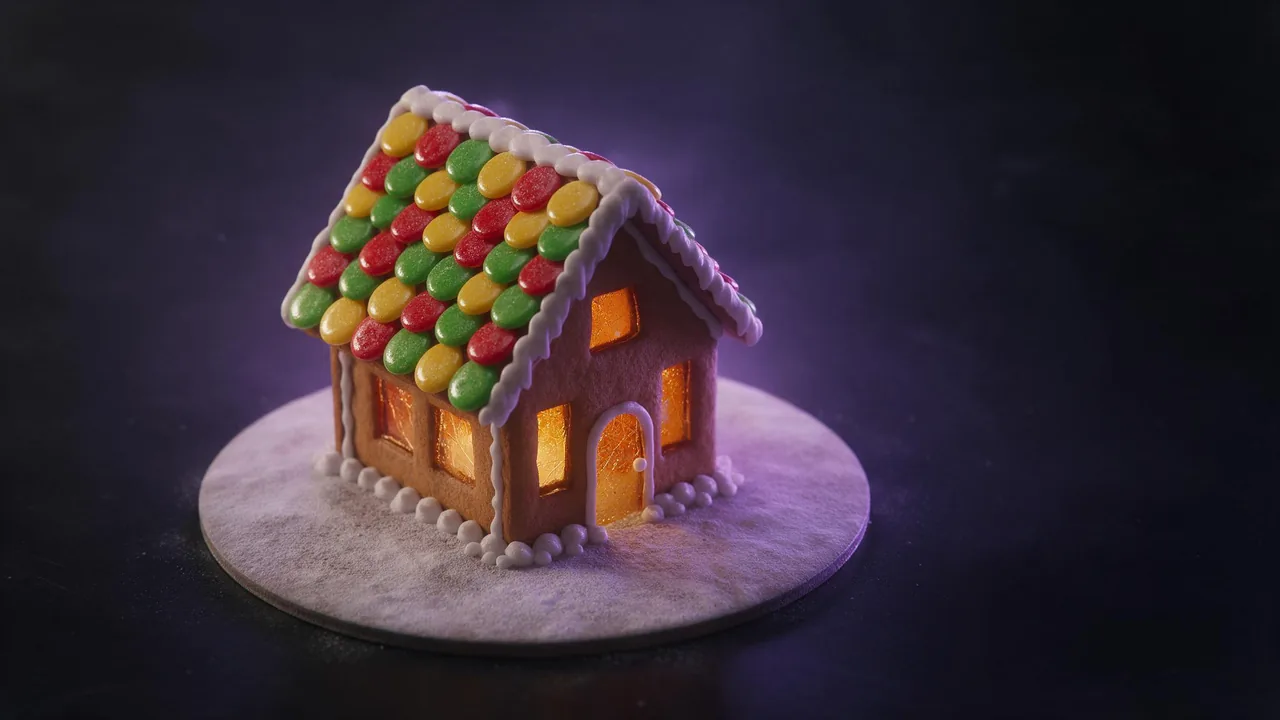
Most gingerbread houses fail on the kitchen table, not in the oven. The roof slides, a wall bows, the windows were cut too close to a corner and the panel snaps. An image model will not bake anything for you, but it is a very fast sketchbook: in a few minutes you can see ten versions of a house, pick the one you actually want to build, and only then cut cardboard. And if you never meant to bake at all, the same picture makes a fine card or a shop banner.
This post treats the house as a small building first and a sweet second. For plated food and recipe shots, read AI food photos for menus and recipes; for knitted patterns, ugly Christmas sweater designs; for a tiny world under glass, snow globe scenes.
Start from what can actually stand
Ask for a pretty gingerbread house and you get a fairy-tale cottage with melting towers, curved walls and a roof that hangs in the air. It looks lovely and nobody could build it. If the picture is a plan for a real bake, describe the house the way a baker would cut it: flat panels, straight edges, simple angles.
- Four walls and two roof panels. Two gable ends with a pointed top, two plain side walls, two rectangles for the roof. Say "simple gable house built from six flat gingerbread panels".
- A steep but not flat roof. Candy tiles and icing snow slide off a shallow slope less than you would think, and a steep one shows off the tiles.
- Windows away from the corners. Ask for one or two windows per wall, centred, with a thick strip of gingerbread around each. That is what keeps a panel from cracking.
- Thick visible edges. "Panels about a finger thick, the cut edges visible at the corners" makes the model draw a house made of slabs, not a painted plastic toy.
The words that make it look edible
Edible materials have their own vocabulary, and the model knows it better than general words like "sweet" or "festive". A few that do real work:
- Gingerbread: dark golden brown, matte, slightly domed surface, tiny bubbles and a darker baked rim on the cut edges.
- Royal icing: bright white, piped in thin lines, small dots and scallops, with soft rounded ends where the nozzle lifted.
- Sugar glass: clear or amber melted candy in the windows, glowing from a light inside, a little uneven.
- Roof tiles: overlapping chocolate buttons, sliced almonds, or flat round mint candies in rows.
- Snow: powdered sugar dusted on the board and the ridge, icing icicles hanging from the eaves.
More on why material words matter, with non-food examples, is in texture and material words for product shots.
A prompt for the finished scene
A hand-built gingerbread house on a round cake board, a simple gable house made of six flat gingerbread panels, dark golden brown, matte, cut edges visible at the corners. Thin white royal icing piped along every edge and around each window, small icing dots under the eaves, icing icicles. The roof covered in overlapping round chocolate tiles in neat rows. Windows of amber sugar glass glowing warm from a light inside. Powdered sugar snow on the board, a short path of crushed candy to the door, two small pretzel-stick fences. Dark kitchen table, soft warm light from the windows, shallow depth of field, three-quarter view.Run it three or four times and change one thing per run: the roof tiles, the icing pattern, the board. When you like a house, keep the prompt and swap only the decoration words, so you compare decorations on the same building rather than four different buildings.
A front view you can trace
The finished scene is beautiful and useless as a template: it is in perspective, so every wall is foreshortened. For cutting, ask for a second image of the same design, flat and straight on.
The front gable wall of a gingerbread house, seen perfectly straight on, flat orthographic front view, no perspective, centred on a plain light background. One door in the middle, one round window above it, white royal icing outlines around the door and the window and along the roof line. Even lighting, no shadows, no background objects.Print it, or open it on a tablet under paper, and trace the outline onto cardboard. Scale it to the size you want with a ruler; the model has no idea how big your oven tray is. Do the same for the side wall, then cut the cardboard pieces and tape them into a dry model before you bake. If the cardboard house stands, the gingerbread one will.
Using it as a card instead
For a card, keep the finished scene and leave room for the greeting: a lot of dark empty table above or beside the house. AI images with space for text shows how to ask for that space, and aspect ratios for AI images helps you pick a frame that fits a folded card or a phone screen. Add the words yourself afterwards in a design tool; letters drawn by the model often come out misspelled.
In the studio, and what it cannot do
Open the studio, pick a text-to-image model from the models page, paste the scene prompt and generate. The price shows on the Generate button before you run it, so test ideas on a cheaper model and keep the stronger one for the final card.
Be clear about the limits. The studio gives you a picture, not a measured template: there are no dimensions, no cut lines, and two images of the same house will not match to the millimetre, so check the side wall against the front wall before you cut. It knows nothing about dough, so the house in the picture might be stronger than yours; a dry cardboard test is still the real check. And a detail such as a name piped on the roof is best added by hand, in icing, on the day.
Questions
Can AI design a gingerbread house I can really build?
It can sketch one. Ask for a simple gable house made of six flat panels, windows away from the corners and visible cut edges, then make a flat front view to trace onto cardboard and test the shape before you bake.
What prompt words make an AI gingerbread house look edible?
Name the materials: matte dark golden gingerbread with baked edges, thin white royal icing lines and dots, amber sugar-glass windows, chocolate or candy roof tiles, and powdered sugar snow on the board.
Does the studio make a printable gingerbread template?
No. It makes images. A straight-on front view is easy to trace, but you set the size and draw the cut lines yourself, and you should check that the walls match before cutting.