Candlelight and firelight words in AI image prompts
Candlelight, firelight and embers: the words that pull an AI render toward warm dim light, how to mix flame sources, and what noise and murk cost you.
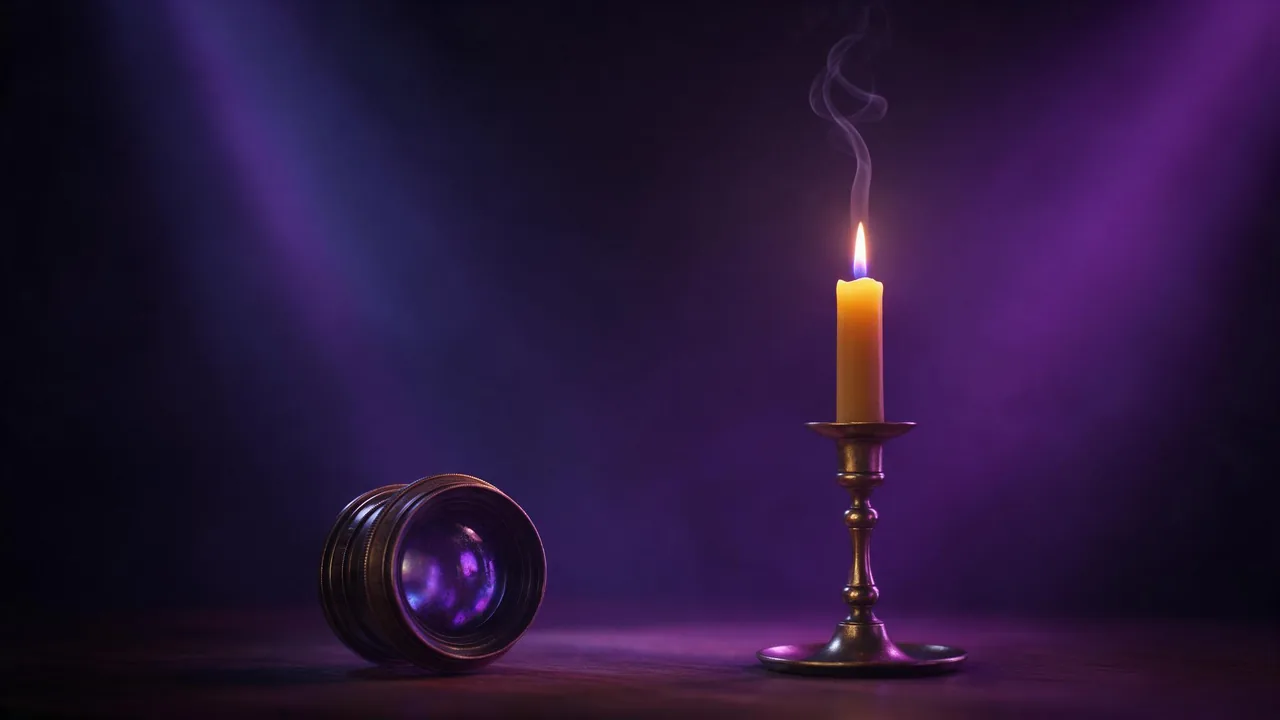
You asked for candlelight and got either a bright beige room or a black rectangle with a matchstick in it. Warm dim light is the most requested mood in prompts and the easiest to fumble, because warmth and dimness are two separate requests. A model will happily make a picture orange; making it genuinely dark, with the light dying off a metre from the flame, takes more. The recipe has three parts: a named flame inside the scene, a dimness request in its own words, and a decision about what the murk may eat.
Put the flame in the frame
Adjectives push, objects pull. "Warm dim lighting" is an instruction about the picture; "two lit beeswax candles in brass holders" is a fact about the scene, and facts render better, because the model has thousands of candle-lit photos behind it and knows where that light lands.
Still life on an oak supper table at night, two lit beeswax candles in brass holders, warm flame glow pooling on the bread, the cheese and a clay jug, the rest of the room falling away into deep shadowThe warm words and where they throw light
Each flame word carries its own physics, borrowed from the photos the model learned from. Pick the source that matches the room:
- Candlelight - a small pool of very warm light close around the flame, fast falloff, soft-edged shadows. The default for supper tables, baths and altars.
- Firelight - stronger and redder, and it comes from below: a hearth lights faces and ceilings off the floor. Say where the fire is.
- Ember glow - the fire is dying. Faint orange on the nearest surfaces, everything else nearly black; the dimmest warm look that still reads.
- Lantern light or oil lamp - portable and directional, with harder shadows than a candle. Good for hallways, porches, desks.
- Dusk window - not a flame, but the partner of one: cool grey-blue from outside against warm lamps inside.
Warm is not dim: ask for the dark half
Left alone, a model asked for candlelight brightens the whole room so nothing is lost, and the mood dies in that kindness. Dimness needs its own words: "night interior", "single light source", "the rest of the room in deep shadow". Two or three, aimed at named parts of the scene, is the working dose; more drifts into the opposite failure, a black mush where the detail used to be. The film word for this shape, mostly darkness with one lit area, is low key, from the vocabulary in cinematic lighting prompts.
An armchair with an open book at night, lit by a single oil lamp on the side table, warm lamplight on the pages and the chair arm, the rest of the room in deep soft shadow, night interiorMixing flames: pick a master
Candles plus a hearth plus a paper lantern in one prompt tends to average out into beige. The model cannot decide which light is doing what, every surface gets the same warm wash, and the shadows stop agreeing. The fix is a hierarchy: name one source as the main light and demote the rest to accents.
A cabin interior at night lit mainly by the stone fireplace, its warm glow reaching the armchair and the rug, one small candle on the shelf adding a secondary highlight, deep shadows in the cornersThe mix that works is warm against cool: candlelight inside against the blue dusk window, firelight with moonlight through a doorway. The colours sit far enough apart that the model keeps them separate. Dark figures against the glow are a different request, covered in silhouette and backlight words.
What the murk costs
Low light is where image models spend their mistakes. The usual bill: grain crawling in the dark areas, skin going waxy next to a flame, fabric texture smoothed flat, shadows that float. Some of it you can ask back in words: clean shadows, rich blacks, sharp detail on the face, or the same phrases in a negative prompt on the models that accept one. Some you cannot: there is no exposure dial, no ISO and no grain slider in the studio. If a render stays too noisy, the after-fix is a denoise or upscale model from the models page, run as its own step.
Counting candles is a real lever
Numbers often do more work than adjectives. "Two candles on the table" doubles the lit area and softens the shadows; "a chandelier of forty candles" gives an even golden wash that reads as a bright room, not a dim one. Too dark? Add one more named flame, not the word brighter. Too even? Remove sources until one dominates. Counting is its own skill; see counting and crowds. In a clip the light itself can move: "candle flame flickering, warm light breathing on the walls" reads well, and more motion words live in image-to-video motion prompts.
The honest limit
Every light decision here is a description, not a setting. There is no exposure compensation, no colour temperature in kelvin, no way to type one stop darker; the model decides how literally to take deep shadow, and two runs of the same prompt can land differently. A face close to a flame can still come out waxy. Expect a few tries, and each try is a full render: a still from Still starts at €0.40. The cheapest teacher is a controlled swap: open the studio, keep one scene fixed, change only the light words between runs.
Questions
Why does my candlelit scene come out bright and orange instead of dim?
Warmth and dimness are separate requests. Flame words set the colour; add dimness words of their own, such as night interior, single light source, deep shadow.
Can I set brightness, exposure or colour temperature directly?
No. The studio has no exposure, ISO or white-balance controls; every light decision is words, and a low-light look can take several runs.
Do more candles make the scene brighter?
Yes, and that is often the wrong direction: more flames give an even golden wash that reads as a bright room. For a dim mood, keep one dominant source.